
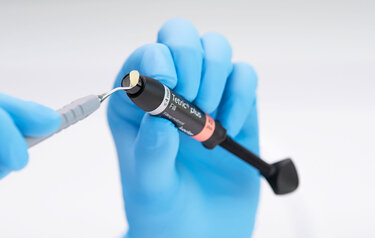
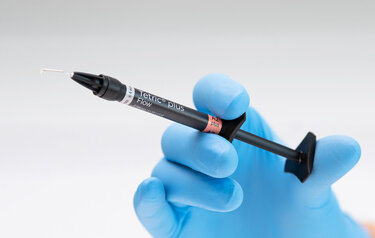
Tetric plus is a modern universal composite that combines simplicity, esthetics and efficiency with handling that users really appreciate. Tetric plus is available in two viscosities: Tetric plus Fill is the sculptable variant and Tetric plus Flow is the thixotropic, low-viscosity variant with self-levelling properties.
To help you get the most out of this universal composite, we have put together a few handy tips from everyday practice.
Tip #1: Adjust the viscosity to suit your needs
If you prefer smoother handling or want the composite to adapt even more closely to fine structures, there is a simple solution: By gently warming Tetric plus Fill (up to a maximum of 68°C), you can adjust its viscosity to your individual preference. The material becomes noticeably softer, offering pleasant handling during contouring.
Practical tip:
Try warming Tetric plus Fill and discover your preferred working consistency.
Tip #2: Contour anterior restorations effortlessly
Over 90% of dentists who tested Tetric plus rated its handling as “very good” or “good”. With Tetric plus Fill, light pressure is enough to shape fine details, such as pits, fissures, proximal contours or the secondary morphology of anterior teeth.
For contouring anterior restorations, we recommend using OptraSculpt Pad. Thanks to its exceptional non-stick properties, this instrument is especially well suited for shaping smooth labial surfaces. In addition, composite brushes have proven effective for shaping vestibular surfaces when working with Tetric plus Fill. These brushes make it easy to achieve smooth transitions between the natural tooth structure and the composite.
Practical tip:
In anterior restorations, applying gentle pressure on the composite is usually enough to achieve the desired contour. In addition to OptraSculpt Pad, it may also be worthwhile to try using a composite brush.
Tip #3: Know how to perform volume replacements swiftly
Tetric plus Flow is distinguished by its exceptional thixotropic properties, combining controlled, precise placement with excellent flowability. Consequently, it covers the application range of Tetric EvoFlow and Tetric PowerFlow in a single material.
For Class I and Class II restorations, Tetric plus Flow is ideal as the initial layer in conjunction with the incremental technique. Thanks to its thixotropic consistency, the material conforms closely to cavity walls, providing reliable adaptation and an excellent foundation for subsequent layering.
Practical tip:
- Use the 1.2 mm cannula for fast volume replacement with Tetric plus Flow in Class I or Class II cavities. With this cannula size, the material is dispensed more quickly, improving both flow and adaptation to the cavity walls.
- After application, allow Tetric plus Flow to disperse briefly in the cavity to let the self-levelling effect take full action. Then light-cure promptly to ensure the material holds its desired shape.
Tip #4: Choose the right cannula size
Did you know that you can influence the way Tetric plus Flow handles just by choosing the right cannula size? Each cannula size has its own advantages that you can leverage for specific purposes in daily practice.
We recommend the 1.2 mm cannula (available as refill) for fast volume replacement in Class I or Class II cavities. If you need more control and stability, use the 0.9 mm cannula.
For Class V cavities, the 0.9 mm cannula is best. We recommend applying the material slowly with low extrusion pressure to increase its stability.
Watch this space for our next blog post.