
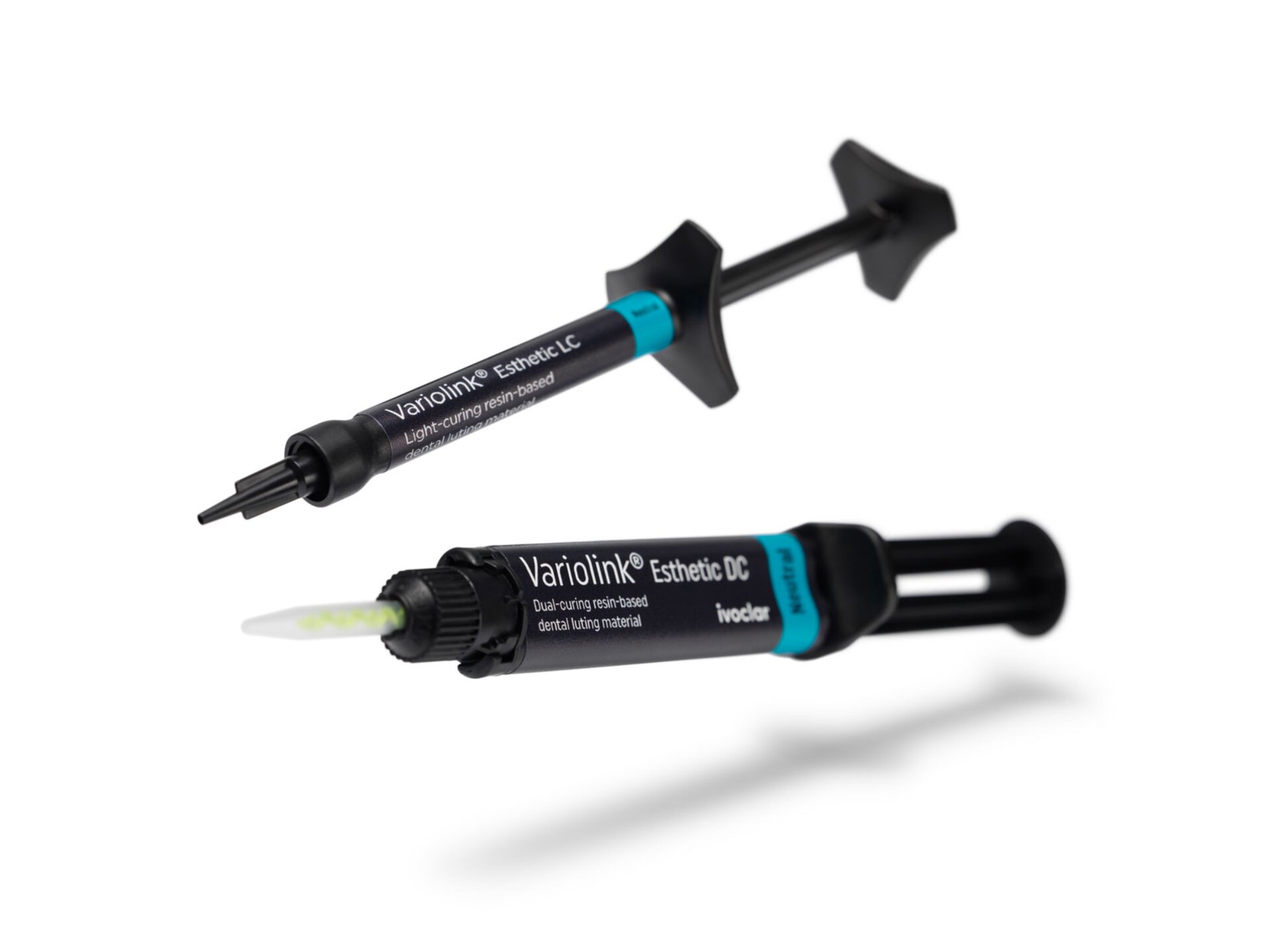
Variolink Esthetic is a light- and dual-cure luting material, which is used for the adhesive cementation of dental restorations. It produces reliable and impressive results. The luting composite is highly versatile and therefore offers exceptional flexibility in choosing a suitable solution for all types of restorations and materials.
Your benefits at a glance

Convincing versatility
- A versatile solution for maximum flexibility in the adhesive cementation of all types of indirect restorations
- Variolink Esthetic DC is suitable for lithium disilicate, glass-ceramic, composite resin, zirconium oxide and metal
- Variolink Esthetic LC is suitable for the adhesive cementation of restorations made of lithium disilicate, glass-ceramic or composite resin, measuring < 2 mm in thickness and showing adequate translucency
Inspiring esthetics
- Well-balanced and compact Effect shade range for impressive esthetic results
- Efficient masking of discoloured preparations with the shade “White opaque”
- Reliable shade stability even when the material is exposed to intensive light or moisture[1] due to the patented Ivocerin light
initiator - Very good wear resistance and margin quality
User-friendly processing
- Easy and controlled excess removal with optional tack-curing[2]
- Flexible situational consistency ensures comfortable handling[2]
- High radiopacity[1,3,4] for easy detection of luting material excess and diagnosis of secondary caries
Versatile adhesive cementation
- Carefully coordinated products for adhesive cementation, developed to work together
- Suitable adhesives for a sound bond to the tooth structure: Adhese Universal and Adhese Universal DC[5-7]
- Reliable bond to restorative surfaces with Monobond Plus and Monobond Etch & Prime[5-10]
- NEW: Reliable bond to tooth structure with the new universal adhesive Adhese 2 – combined with the blue DC cannula for indirect restorations and endodontic posts[11]
Optimized viscosity
Variolink Esthetic LC
- Improved tactile feedback when positioning and aligning veneers thanks to its higher viscosity
Variolink Esthetic DC
- Optimal cementation of restorations in the posterior region
Longterm clinical performance
Variolink Esthetic DC
- Long-lasting, reliable performance and high stability: 94.5% survival rate for IPS e.max CAD restorations after 7 years in situ[12]
- Excellent marginal integrity and resistance to marginal discolouration:
Esthetic results, clinically proven for up to 7 years[12]
Variolink Esthetic LC
- Long-lasting, reliable, and esthetically stable results[13]
Coordinated materials for Variolink Esthetic


The effect shade concept
From try-in to placement

Variolink Esthetic – for the highest esthetic demands
Variolink Esthetic offers a well-balanced and clearly structured effect shade concept that ensures harmonious integration of the restoration while allowing for additional personalization of the final result.
- Neutral offers a high level of translucency for a shade-neutral cementation
- Light / Light+ enable a gradual lightening effect of the restoration
- Warm / Warm+ support gradual darkening of the overlying ceramic or composite restoration
- White opaque facilitates efficient masking of discoloured tooth structure
Variolink Esthetic offers a well-balanced and clearly structured effect shade concept that ensures harmonious integration of the restoration while allowing for additional personalization of the final result.
- Neutral offers a high level of translucency for a shade-neutral cementation
- Light / Light+ enable a gradual lightening effect of the restoration
- Warm / Warm+ support gradual darkening of the overlying ceramic or composite restoration
- White opaque facilitates efficient masking of discoloured tooth structure

Variolink Esthetic Try-In Pastes
Selecting the right shade is essential for achieving an optimal esthetic result. Variolink Esthetic Try-In Pastes allow for an easy and precise simulation of the final outcome before definitive cementation.
- Effect shade range – Try-In Pastes match the shades of the final luting composite exactly
- Simple and reliable – effortless try-in and verification of the final esthetic result
Selecting the right shade is essential for achieving an optimal esthetic result. Variolink Esthetic Try-In Pastes allow for an easy and precise simulation of the final outcome before definitive cementation.
- Effect shade range – Try-In Pastes match the shades of the final luting composite exactly
- Simple and reliable – effortless try-in and verification of the final esthetic result
Why dental professionals choose Variolink® Esthetic
Flexible consistency
Easy excess removal
Frequently asked questions about Variolink® Esthetic
A dual-curing cement (DC) is a two-component cement with both light-curing and self-curing properties. The self-curing process occurs via a chemical reaction between the components, independent of light. Light-curing is initiated by irradiation with a polymerization device. Variolink® Esthetic DC is suitable for all types of restorations and materials in both the anterior and posterior regions. Dual-curing is particularly advantageous when light cannot fully penetrate the restoration (e.g., thick crowns or bridges), or when restorations are made from opaque materials (such as zirconium oxide, metal alloys). In these cases, the self-curing component ensures complete polymerization.
A purely light-curing cement (LC), such as Variolink® Esthetic LC, is a single-component cement. It is indicated for thin highly translucent restorations with a layer thickness of less than 2 mm, such as veneers as well as inlays, and onlays made of lithium disilicate, glass ceramics or composite materials.
Please refer to our guide to adhesive cementation for further information on the various cementation protocols.
Adhesive cementation refers to the permanent bonding of restorative materials to tooth structure by chemical adhesion, using adhesive bonding techniques. Adhesive cementation is primarily associated with the placement of demanding esthetic restorations such as glass-ceramic veneers, inlays and onlays. Adhesive cementation composites such as Variolink Esthetic boast a unique range of effect shades, ensuring restorations blend in smoothly in the patient’s mouth.
In some situations, adhesive cementation is even mandatory because the clinical situation or restorative material requires it:
- Indirect restorations on non-retentive preparations, regardless of the material used
- Restorations made from materials with comparatively low flexural strength such as IPS Empress CAD (below 300 MPa)
More detailed clinical recommendations can be found in our guide to adhesive cementation.
In most cases, teeth restored with indirect restorations such as crowns, bridges or veneers often no longer have intact tooth structure. Typical challenges include distinctly chromatic dentin, tetracycline staining or a greyish discolouration as a result of endodontic treatment. These unevenly coloured tooth preparations can be particularly challenging, especially when restoring adjacent teeth with all-ceramic restorations. To allow for shade adjustments even in such cases, the shade “White opaque” has been developed. With the help of our Try-In pastes you can simulate the esthetic effect of the chosen shade prior to adhesive cementation in order to obtain a harmonious overall appearance.
Ivoclar offers a reliable solution for the adhesive cementation of indirect restorations – ensuring strong adhesion, high stability and esthetically pleasing results. Explore our step-by-step guide to quickly and confidently determine the appropriate protocol for the diverse patient cases you manage every day. Explore now
In internal test series, the new Adhese 2 achieved high shear bond strengths to dentin and enamel (> 25 MPa), regardless of the etching protocol used. In self-etch applications, it showed the best results compared with other tested combinations of universal adhesives and luting composites. More information in our Variolink brochure.
Product comparison

[1] Gianasmidis A, DZW 2016 (38), p. 14–15, données complémentaires disponibles dans le dossier.
[2] Gianasmidis A, DZW 2016 (39), p.18-19, données complémentaires disponibles dans le dossier.
[3] Erzurumlu ZU et al., Clin Oral Investig 2021 Vol. 25 (10), pp. 5735–5741.
[4] Westphal M et al., IADR Abstract #0918, 2018, données complémentaires disponibles dans le dossier.
[5] Maassen, et al, J.Prosthet Dent, 2021, p. 182-188, données complémentaires disponibles dans le dossier.
[6] Aslan Y U et al., Eur J Prosthodont Restor Dent, 2019 (27), p. 131-140.
[7] Salem S K et al., EDJ, 2019, 65, p. 1853-1864.
[8] Elsayed A et al., IADR Abstract #2657, 2017.
[9] Lyann S K et al., J Adhes Dent, 2018 (20), p. 261-268.
[10] Guimaraes H A B et al., Int J Biomater, 2018, p. 1-7.
[11] Dual-curing (light- and self-curing) only in conjunction with the blue DC cannula and dual-curing core build up or luting composites
[12] Sorensen JA et al., IADR Abstract #1214, 2025.
[13] Edelhoff D, Prospective clinical application observation, Study Report, University of Munich, 2019.
[14] Ivoclar Vivadent AG, enquête clients (approx. 700 participants) en Europe/USA, Septembre 2016.
[15] Sauf dans les cas où une exposition suffisante à la lumière de polymérisation ne peut être garantie (par exemple, collage de tenons endodontiques).