
Anyone who has ever baked a cake knows that appearances can be deceptive: it may look perfectly done on the outside while still being underbaked in the middle. That is because the heat has to reach the centre and remain there long enough to bake the cake through. A similar phenomenon can be observed with the curing depth of composites. If the material is not adequately cured throughout, the deeper layers remain incompletely polymerized, resulting in a restoration with poor mechanical properties. This is particularly relevant for bulk-fill composites, which have to cure reliably in deep cavities in increments of up to 4 mm. That is why, in addition to measuring depth of cure according to ISO 4049, we assess Vickers hardness.
Materials science offers a wide range of test methods for assessing mechanical properties. In dentistry, mechanical testing can indicate how a material is likely to perform clinically. Standard test methods, however, often look at one type of load in isolation, whereas the stresses a material is exposed to in clinical practice are far more complex. Even so, laboratory testing allows different materials to be compared directly, provided they are tested under exactly the same conditions.

A method for determining the maximum increment thickness of resin composites was introduced by the International Organization for Standardization (ISO) in 1988, in the second edition of ISO 4049.[1] In this classic method, the composite is placed in a cylindrical mould, light-cured from one side and then removed from the mould. Any uncured material at the bottom is then removed (“scraped off”) with a spatula, leaving a hard cylindrical specimen.[2] Finally, the total length of the cured specimen is measured and divided by two. The resulting value is recorded as the depth of cure and defines the maximum increment thickness. The reason for dividing by two is that material near the bottom may no longer be soft enough to be scraped away, yet may still not be fully cured. The effectively “safe” depth is therefore smaller than the thickness of the remaining specimen. This ISO 4049 method has remained essentially unchanged to this day.
In the video, we use a simplified test to demonstrate the depth to which Tetric® plus cures. The demonstration is based on the testing principle described in ISO 4049 but does not constitute a standardized test according to the ISO standard.
The ISO method in practice:
If the specimen is 4 mm long after scraping, the depth of cure is reported as 2 mm (half the length), even though the mechanical properties in fact decline gradually from top to bottom.
While the test method itself has remained unchanged, composites have evolved continuously over the years and key components such as fillers and initiators have changed with them. Bulk-fill materials, in particular, have required changes to their composition. It is therefore important to reassess the accuracy of the ISO method and its divide by two rule. Several studies suggest that this method may systematically misrepresent the actual depth of cure, particularly in bulk-fill composites.[3]
The reason: The ISO method only distinguishes between material that can be scraped away and material that cannot. It therefore indicates how deep into the composite sufficient polymerization has occurred[3], but does not account for the gradual change in hardness through the depth of the composite. As a result, it does not reveal how thoroughly the material is cured at different depths or how well it can withstand mechanical loading.
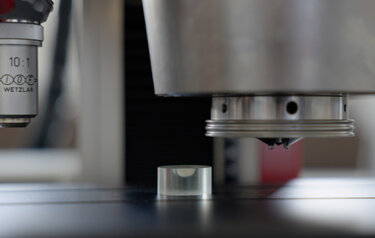
The Vickers hardness test was developed in 1925 by Robert L. Smith and George E. Sandland, both working at Vickers Ltd.[4] In this test, a synthetic diamond in the shape of a square-based pyramid is pressed vertically into the surface of the specimen under a defined load. The pyramid leaves a square indentation in the material, with an angle of 136° between opposite faces. The Vickers hardness value is calculated from the average length of the two diagonals of the indentation. It represents the ratio of the test load applied to the diamond, expressed in kg, to the surface area of the resulting indentation, expressed in square millimetres. Put simply: the larger the indentation, the softer the material. The size of the indentation can therefore be used to calculate the material's hardness.
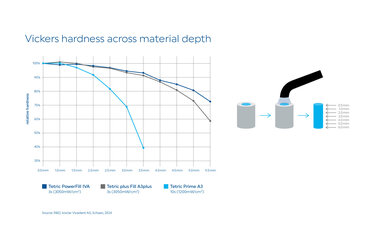
As bulk-fill composites need to cure reliably to a depth of 4 mm, Vickers hardness is measured not only at the surface but also at defined distances from the exposed surface. This provides a hardness profile across the entire depth of the specimen.[5] Hardness decreases with increasing depth as light intensity diminishes, resulting in a lower degree of polymerization. The hardness profile therefore provides a reliable indication of how the material’s properties vary with depth.
"Down to a depth of 4 mm, hardness remains at least 80% of the surface hardness. Beyond this depth, the material becomes noticeably softer." This provides a much closer reflection of clinical reality than a single ISO 4049 value.[3]
Tetric plus: reliable and esthetically pleasing
Our universal composite Tetric plus can be placed in increments of up to 4 mm. Materials designed for such increment thicknesses are generally more translucent, allowing sufficient light to reach the initiators deeper within the material. However, if the material stays this translucent after curing, it can compromise the esthetic result. Tetric plus addresses this challenge with an optimized filler and photoinitiator technology: Its high initial translucency allows light to penetrate deep into the material, while a change in translucency during curing gives the cured material a more opaque, natural appearance. As a result, Tetric plus combines reliable depth of cure with pleasing esthetics, even at low curing energy.

To reliably assess the depth of cure, we subjected Tetric plus to Vickers hardness testing. Here, Vickers hardness is expressed as a percentage of the surface hardness, which is defined as 100%. In a study by Professor David Watts of the University of Manchester, UK, an acceptable depth of cure was considered to have been achieved when hardness at the bottom of the specimen was at least 80% of the surface hardness.[6]
Our testing showed that, while Tetric plus does not achieve the highest depth of cure compared with other materials, it cures reliably at a depth of 4 mm while also delivering highly esthetic results with short exposure times starting from just 3 seconds.[7]

Watch Dr Philipp Bielec, Head of Composite Materials Development, as he puts Tetric plus through Vickers hardness testing.
[1] ISO 4049:1988 (2.). Dentistry—resin-based filling materials. International Organization for Standardization; 1988.
[2] Blog dental materials, 22/05/2011: https://dental-materials.blogspot.com/2011/05/how-to-measure-depth-of-cure-of.html, viewed on 09/09/2026
[3] Flury S, Hayoz S, Peutzfeldt A, Hüsler J, Lussi A. Depth of cure of resin composites: Is the ISO 4049 method suitable for bulk fill materials? Dent Mater. 2012 May; 28(5):521-8. doi: 10.1016/j.dental.2012.02.002 Epub 2012 Mar 3. PMID: 22391146
[4] R.L. Smith and G.E. Sandland, 'An accurate method of determining the hardness of metals with particular reference to those of a high degree of hardness' proceedings of the institution of mechanical engineers, vol. 1, 1922, p623-641.
[5] Ilie N, Hilton TJ, Heintze SD, Hickel R, Watts DC, Silikas N, Stansbury JW, Cadenaro M, Ferracane JL. Academy of Dental Materials guidance-Resin composites: Part I-Mechanical properties. Dent Mater. 2017 Aug; 33(8):880-894. 10.1016/j.dental.2017.04.013 Epub 2017 May 31. PMID: 28577893
[6] Watts D, Amer O, Combe E. (1984). Characteristics of visible light-activated composite systems. Br Dent J. Vol156 (6) 209-215.
[7] With Bluephase PowerCure in the 3sCure mode (light intensity of 2700–3300 mW/cm2). Only suitable for Class I and II restorations in the posterior region, light cured from the occlusal aspect.