
While shade selection is a routine procedure for most clinicians, it can still be time-consuming and create uncertainty, especially in cases involving esthetically demanding restorations that require choosing from a wide range of shades, opacities and variations.
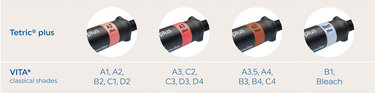
Tetric plus takes a different approach with a purposefully streamlined system: Just four coordinated universal shades that cover the complete VITA[1] shade spectrum. This simplifies decision-making without compromising on accuracy or esthetics. The result: a more efficient workflow and consistently reliable esthetic outcomes – regardless of the clinician’s level of experience or routine.
The material’s enhanced chameleon effect made it possible to narrow down the number of shades– but that is not all. We carefully selected the pigments for each shade with intention. Our goal was clear: to ensure that the streamlined range of shades genuinely covers the full spectrum of natural tooth colours. To achieve this, we developed an evidence-based shade concept inspired by the colour of natural teeth and found in the teeth of your patients.
You may already have noticed that some VITA[1] shades do not occur with the same frequency in natural teeth. This is why you reach for an A3 far more often than a C2 in clinical practice. When developing the simplified shade system of Tetric plus, we took advantage of this uneven distribution and learned from it.
Our decision to use exactly four shades was not arbitrary – it emerged from analysing the shade distribution in natural teeth.
We examined 368 teeth intraorally using a spectrometer, generating Lab* values (L = brightness, a = red-green, b = yellow-blue) that we then mapped onto a coordinate system. This resulted in a colour cloud that visually depicts the colour space of natural teeth.

Visual representation of the colour dots measured using a spectrometer.
"This green area was the basis for the development of the shades. All natural tooth colours we measured fell within this area – it essentially represents the colour space of natural teeth." – Dr Benjamin Gebhardt, Director R&D 3D Printing Organic Materials
Our data analysis revealed where data points tend to cluster and how they naturally group into ‘shade clusters’ or ‘shade clouds’. This led us to identify three shade clouds, which shaped the design of the streamlined shade system of Tetric plus.
We also incorporated the VITA[1] shade system into our analysis, as it was important for us to build on a reference system already established among dentists. For this purpose, we measured the Lab* values of the VITA[1] shade guide, included these measurements in our analysis and refined the shade cloud: This led to a clear grouping into A2 plus, A3 plus and A3.5 plus. To optimize results for the B1 shade and provide an option for bleached teeth (which fall outside the range of natural tooth colours), we decided to develop a fourth shade: Bleach plus.

Data points grouped into 4 shade clouds – the basis for the 4 shades of Tetric plus.
Once our analysis was complete, we moved to fine-tuning the materials. Again, we used natural teeth representing each shade cloud as our reference points, selecting several extracted human teeth from each shade cluster and gradually refining our formulation to achieve adequate matches. We also ensured that the shades of Tetric plus Fill and Tetric plus Flow were aligned with each other. Naturally, this required several rounds of refinement before our in-house experts were satisfied with the results.

“To ensure the shades really do cover the entire cloud area, we also tested ‘borderline colours’ for a good fit.”
Dr Philipp Bielec, Team Leader Composites
Dr Philipp Bielec, Team Leader Composites
Next, we validated the shades with an extended group of in-house test users. To truly challenge the limits of the chameleon effect, our testers were required to place both posterior and anterior restorations in various extracted human teeth. Finally, our test users evaluated the esthetics of all restorations using FDI criteria. We only finalized the shade formulations after all testers were satisfied with every shade and the FDI ratings met our quality standard
This is how we developed the 4 shades that cover all 16 VITA[1] classical shades and bleach. The final shades satisfied not only our team, but also the more than 170 esthetics evaluators involved in the testing process.[2]

“The result is a simplified universal composite based on natural tooth colours. At the same time, the shade system remains familiar, making shade selection easy and intuitive for dentists.“
Anja Stouten, Head of Department Mature Markets Direct Restoratives
Anja Stouten, Head of Department Mature Markets Direct Restoratives
Discover even more insights about Tetric® plus! Dive into how our four shades were inspired by natural tooth colors, or read how the Simplified Universal Composite can truly make your daily practice easier. We’ve linked all blog posts related to Tetric® plus in one place – so you won’t miss a single detail.
[1] No registered trademarks of Ivoclar Vivadent AG.
[2] Internal study based on more than 170 participants. 81% rated the shade match as ‘exact’ or ‘strong’.